Hamilton Jazzmaster Viewmatic Open Heart:
The Skeleton That Knows When to Stop
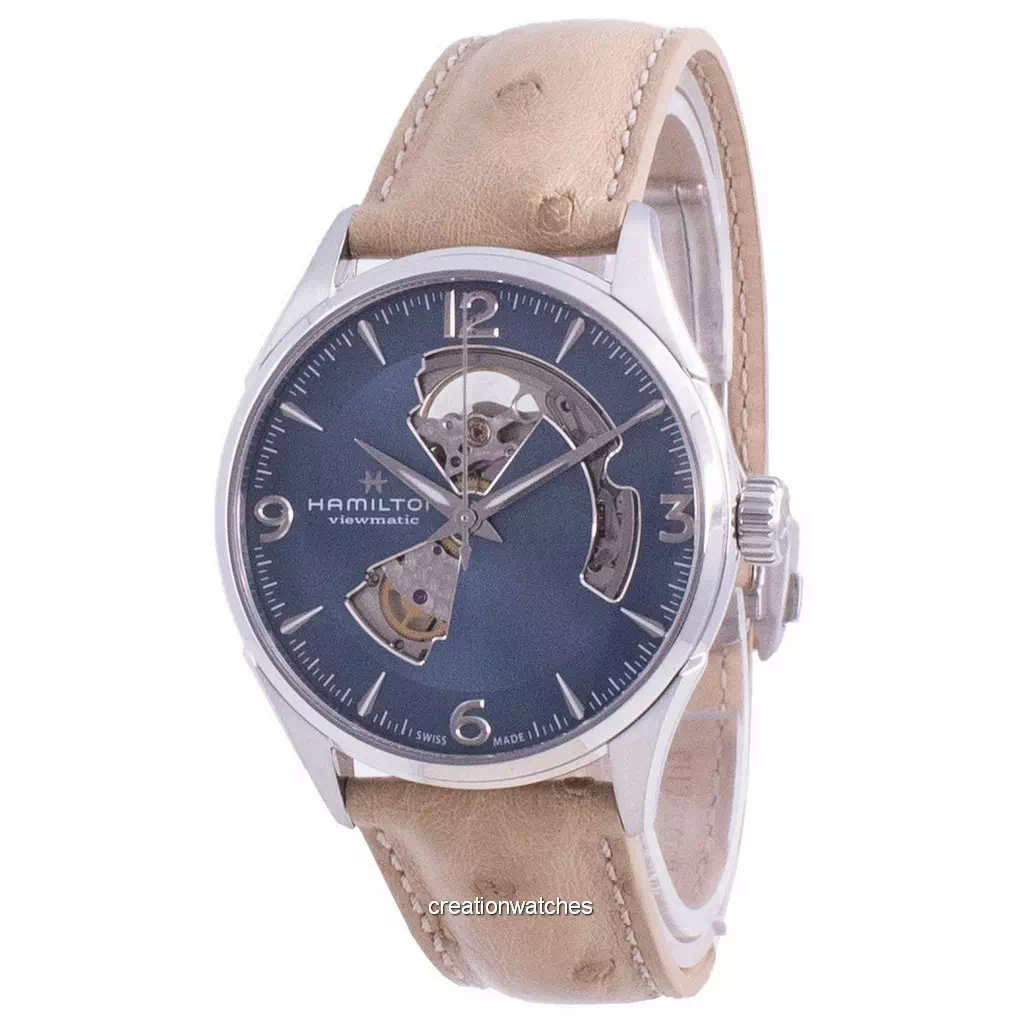
Open heart dials usually feel like someone took a perfectly good watch and punched a hole in it because the marketing team needed a "wow feature." Most of them are gimmicks — a cutout shaped like a clover or a crescent, revealing a movement that wasn't designed to be seen. The Hamilton Jazzmaster Viewmatic Open Heart is different. It works because Hamilton started with a movement worth showing, then subtracted exactly what needed to disappear.
The Clymer Principle: Restraint Above All
When Hodinkee's Jack Forster discussed skeletonization, he often returned to a simple truth: exposing a movement isn't the same as celebrating it. A full skeleton can look like a watch that got into an accident with a laser cutter. An open heart, done wrong, is worse — it reveals an unfinished, utilitarian view of the movement that reminds you what you can't see.
Hamilton sidesteps this by keeping the dial intact except for a single, precisely shaped aperture at 12 o'clock that cuts through the silver sunburst surface. The opening reveals the balance wheel in motion — the beating heart, literally — while the rest of the dial maintains the clean, mid-century elegance that makes the Jazzmaster a perennial dress-watch contender. It's the difference between a museum and a dissection.
Adams on Connection: The Window Into Mechanical Life
There's a reason open heart dials have survived while other trends have faded. As collector and writer Ariel Adams would put it, the open heart creates something no solid dial ever can: a visual relationship between the wearer and the machine. You see the balance wheel oscillate at 21,600 vibrations per hour — not as a number on a spec sheet, but as a tiny, constant dance beneath an arched window. It's a reminder that this isn't a battery pushing hands around. It's physics, gravity, and steel, working together eight times every second.
On the 42mm stainless steel case with its polished bezel and slim profile (just over 11mm thick), that window feels intentional — architectural, even. It curves gently at the top of the dial, framed by applied indices and dauphine hands that catch light from every angle. You glance at the time, but your eye always lingers on the aperture for a second longer than necessary. That's the point.
Forster Precision: The H-10 Movement Under the Hood
Here's where Hamilton separates itself from the open-heart pack. The caliber H-10 is a serious movement — a Swatch Group workhorse based on the ETA C07.811, but that description undersells it. Hamilton has endowed it with three key attributes that make it worth exposing:
Eighty hours of power reserve. Wind it on Monday morning, and it's still running on Friday afternoon. That's nearly double the standard 42-hour reserve found in most ETA 2824-based watches. You can take it off for a weekend and come back to find it ticking.
Nivachron balance spring. Anti-magnetic, anti-shock, resistant to temperature variation. It's a metal alloy developed by Swatch Group's Nivarox-FAR subsidiary, and it puts the H-10 comfortably ahead of any entry-level automatic in terms of real-world accuracy.
Thoughtful decoration. Most open heart watches hide the movement behind a solid caseback because the movement wasn't designed to be seen. Hamilton did the opposite — the H-10 visible through the sapphire exhibition caseback is the same movement that appears through the dial aperture. Perlage on the bridges, blued screws, circular graining on the plates. It's not haute horlogerie, but it's honest work, properly finished for its price point.
The Viewmatic Heritage: 1960s Roots
The "Viewmatic" name isn't new. Hamilton introduced it in the 1960s as a line defined by its front-facing display — a transparent window onto the movement. The modern Jazzmaster Viewmatic carries that DNA forward with a more refined execution. Where the 60s original was a product of its era — bold, experimental, mid-century modern — the current generation is quietly confident. The silver dial with its subtle sunburst finish catches light like vintage instrument panels, and the date window at 3 o'clock is positioned without fuss.
The result is a watch that belongs equally in a boardroom and a weekend coffee shop. Pair it with a suit and it reads as tasteful. Wear it with a selvedge denim jacket and it reads as intentional. The leather strap (black or brown, depending on your configuration) breaks in quickly and adds to the overall less is more philosophy.
"Most open heart watches reveal a movement because they have to — they need a selling point. The Jazzmaster Viewmatic reveals its movement because the H-10 deserves an audience. That's the difference between marketing and craftsmanship."
At $704, a Serious Value Proposition
Consider the competitive landscape: a Swiss automatic from a brand with real heritage (Hamilton was founded in Lancaster, Pennsylvania in 1892, and has been Swiss-made since 2003), an 80-hour power reserve, a sapphire crystal both front and back, and an open heart execution that doesn't feel like a compromise. At $704.72, the H32705842 sits in a sweet spot where you're paying for movement quality and thoughtful design — not just a logo on the dial.
If you're looking for your first Swiss automatic, this is a strong candidate. If you're a collector looking for an honest daily wearer with a view into the mechanics, it's an even stronger one. The Jazzmaster Viewmatic Open Heart reminds you that you don't need to see everything to appreciate what's inside. Sometimes one well-placed window is worth more than a full glass facade.
At a Glance: Hamilton Jazzmaster Viewmatic Open Heart H32705842
- Movement: Hamilton Caliber H-10 (Automatic, 80h power reserve, 21,600 vph, 25 jewels)
- Case: 42mm stainless steel, polished bezel
- Dial: Silver sunburst with open-heart aperture at 12 o'clock
- Crystal: Sapphire (front & exhibition caseback)
- Water Resistance: 50m (5 bar)
- Strap: Leather with standard buckle
- Heritage: Viewmatic line originally introduced in the 1960s
- Price: $704.72
This piece and hundreds more are waiting to become part of your story.
Explore the Collection